

*Warning: This word — the actual word — is a prominent part of the article below. It has been somewhat sanitized in the title because, I understand, it’s a word that can shock, cause discomfort, and shut down readers before they even get to the substance — but please understand, as a person of color, as an African American and as a gay black woman, I encounter this word and its accompanying degradation every day; hopefully that truth is even more shocking and uncomfortable.
Equity, inclusion, and justice within the legal profession are under attack and it’s time to fight back. The legal profession is not the place for racist individuals, biased laws, and hateful rhetoric, yet they continue to find space to flourish.
People of color, underrepresented groups, and allies at all stratums within the profession are under assault. The stories are consistent and the experiences are a microcosm of greater society. Since the beginning of colonization, conquered, oppressed and marginalized individuals and groups have been working to create an equitable landscape. The overarching response from those in power — predominantly, but not limited to white males — reveals the lived core values of our country.
From sports brands to coffee machines, anyone who reveals an allyship or affinity for the development of equitable laws and opportunities runs the risk of being attacked. Our country is politically polarized, and the divisiveness has reached an all-time high. The racist history of this country is real and it is still in full effect. When “niggers” rise in any capacity, the status quo is challenged and racism strikes back. With every generation racism has taken on a new form and required a different response to educate the ignorant, combat the effects, mitigate its growth, and strive for its obliteration.
The legal profession is not immune. Case in point: On Aug. 17, 2017, Pierce County Superior Court Judge Helen Whitener organized a one-day workshop called The Color of Justice as a way to address the “gavel gap.” The goal of this workshop was to encourage young women of color between the ages of 11 and 18 to consider a career in the legal profession and more specifically, to learn more about becoming a judge.
The event was an amazing opportunity to build awareness, encourage growth, and be involved with the community. KING5-TV covered the story and showcased the young women and judges who participated. It was a beautiful sight. Young women of color were galvanized to make their dreams a reality and to rise above the oppression that characterizes so many of their lives.
Some reactions to Judge Whitener’s effort were filled with hate. She received a number of responses that underscored the reality that most people of color, expressly African Americans, are familiar with:
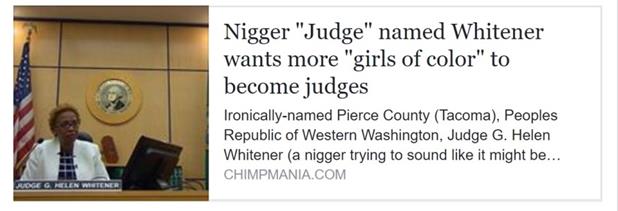

The individual who sent these images to Judge Whitener did not identify themselves, but a white supremacist website is named as the origin. They actually took the time to create the images and language and sent them to Judge Whitener. Clearly the author is tracking events — or at least paying attention to news — about the legal profession.
Negative responses like this underscores why the Washington State Bar Association is invested in advancing diversity, inclusion and equity. The response also underscores the continued need for allies to not only speak up but to step up their own personal and collective efforts in advocating for systemic change across the legal profession. No more talking without walking. We need to take action.
I am not surprised or put off by the response to Judge Whitener’s event. I expect it. I have developed this expectation based on the history of race relations in our country. I have personally experienced enough overt racism and not so subtle microaggressions to understand there are still plenty of people who believe that black people are “niggers” and all the stereotypes associated with it.
The use of the word “nigger” written in this context seems to be an attempt at demeaning the person and the event. Instead, what it does is reveal a truth many of us would like to ignore and forget; we live in a society that assigns the value and worth of a person based on the color of their skin. The word “nigger” is meant to oppress. The word “nigger” is meant to marginalize. The word “nigger” is meant to cause emotional and intellectual harm. People like me have learned to reject the harmful intent and to use that intent as an impetus to continue rising.
There are open and covert racist legal professionals practicing law. There are also powerful, awake, and astute people of color and their allies working to dismantle the laws and policies that underpin the acceptance and display of racist behavior and decision making.
It’s time to choose a side and it’s time to get to work. Silence will not protect you or the status quo. Are you on the side of inclusion, equity, and justice? Or are you paying homage to the support of racist ideology in practice and word?
There are a plethora of opportunities that exist to combat overt racist behavior, implicit, and explicit bias, and microaggressions within the legal profession. From joining anti-racist efforts to engaging in training or partnering with local community organizations and education, the opportunities are boundless.
The fundamental principles of the Washington Supreme Court’s Rules of Professional Conduct state that “The continued existence of a free and democratic society depends upon recognition of the concept that justice is based upon the rule of law grounded in respect for the dignity of the individual and the capacity through reason for enlightened self-government.” This opening statement is clear; justice is up to us and our capacity for enlightenment and the respect we hold for others are direct influencers. As “niggers,” we will continue to rise with Judge Whitener and thousands of other legal professionals in the pursuit for justice and equality for all people. We challenge you to join us by speaking up and taking action.
In the words of Maya Angelou:
You may write me down in history
With your bitter, twisted lies,
You may trod me in the very dirt
But still, like dust, I’ll rise…
 K. Joy Williams. Joy serves as the Diversity Program Manager at WSBA. She earned her masters degree in Public Administration from Seattle University and her bachelor of arts in urban studies from the University of Washington. She can be reached at JoyW@wsba.org.
